ContentWise Edge Smart Home
Hardware root of trust for Edge AI in unattended locations.



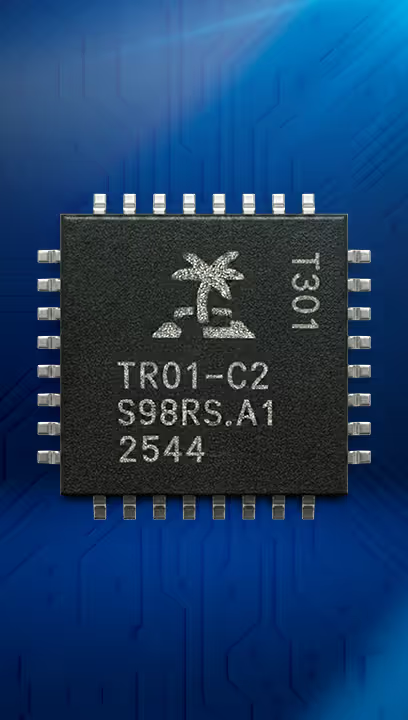
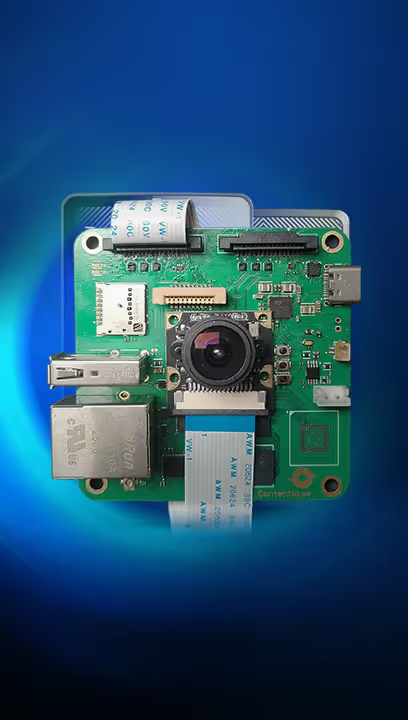
Contentwise Edge Smart Home devices, for example: cameras, lights, gateways, and controllers, run on Linux (OpenWRT) with edge AI hardware that processes data locally, strong connectivity (Ethernet, Wi-Fi, Bluetooth), and TROPIC01 embedded by default as the platform’s secure element.
Why Smart Homes Need Hardware Security
Smart home devices combine local intelligence with hardware-rooted security. Traditional smart home devices make fundamental security versus convenience trade-offs. Cloud processing exposes data, local processing lacks verification, software security can be bypassed, and closed secure elements still require blind trust.
Smart home devices face overlapping threats: malicious firmware, physical theft, device impersonation, compromised supply chains, and tightening regulation like CRA. Software alone can't cover all of these.
.png)
How TROPIC01 Enforces Edge Smart Home Security
Inside the smart devices, TROPIC01 anchors trust in hardware, not software. Silicon variations create device-specific keys that vanish when powered down. Immutable boot anchors verify firmware before execution. Tamper sensors trigger protective responses. The cryptographic proof of device state with security guarantees that exist below the attack surface.
Each chip has a unique identity derived from its Physical Unclonable Function (PUF). Manufacturing variations in the silicon create device-specific keys, modifying chips' behaviour to prevent replay attack and cloning. PUF keys never exist physically when the chip is powered down and cannot be extracted even with physical die analysis.
How TROPIC01 Enforces Edge Smart Home Security
Together, these mechanisms create a chain of trust from power-on to runtime operations anchored in hardware, transforming each smart home device into a provably trustworthy node critical for connected environments.
Secure Boot & Updates
Each TROPIC01 derives identity from its PUF. Remote systems verify device authenticity before establishing trusted sessions. Multiple EdgeAI boards can mutually attest to each other, detecting OS or application tampering across distributed deployments.
Tamper Detection
Edge AI devices produce results that trigger real-world actions: access granted, alarm triggered, anomaly detected. TROPIC01 signs inference results, binding them to verified device identity and firmware state. This provides cryptographic evidence that a specific, authenticated device produced a specific result.
Runtime Protection
- Remote Attestation: Challenge-response protocols prove device state to cloud backends
- Secure Communication: TLS/Noise channels using on-chip keys
- Data Integrity: Signed logs and 237.5KB encrypted storage
- Audit Trail: Cryptographic event tracking that cannot be forged
Don’t wait — start building now!
Be among the first to innovate with the TROPICO Devboards.
Globally available and ready to ship within days.